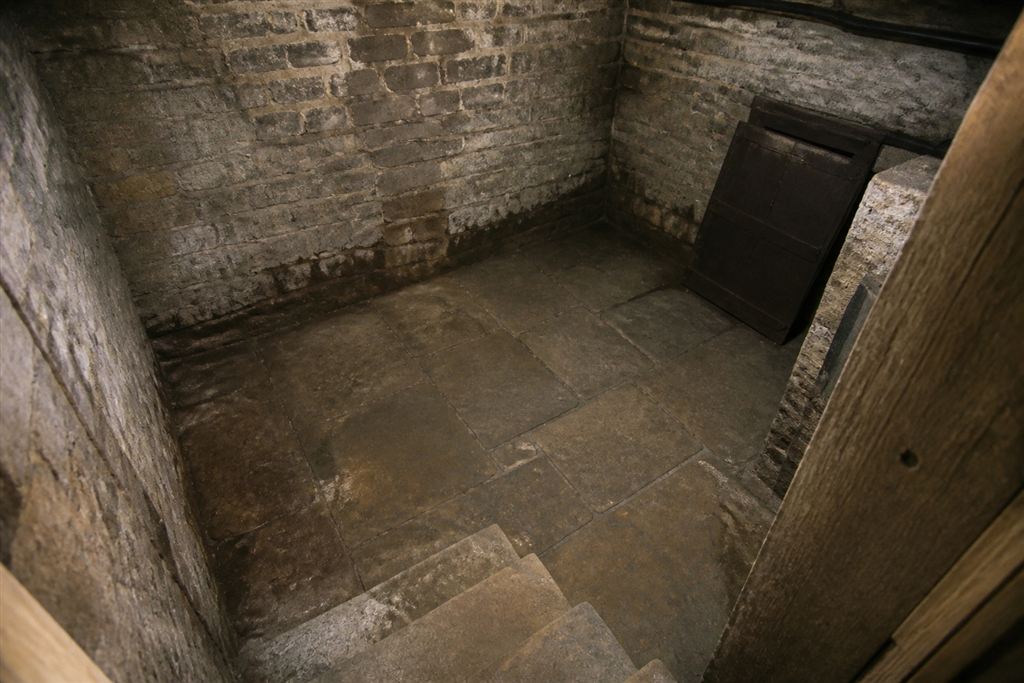
What “tanking a cellar” means on this stock
On a tight LS17 through-semi the phrase is a job, not a tin of slurry:
- the room is small, often one bay under the hall, with a party wall you do not own outright
- the wet shows at the floor/wall joint and at the hatch or chute, not as a lake in a mill hole
- you still need to use the room (boiler, freezer, shop stock) while the brick stays in the ground
- there is rarely a rear yard in which to hide a new soakaway
“Tanking a cellar” in Moortown therefore means: decide whether a drained cavity (Type C) will keep the room usable, or whether a limited barrier repair is honest on a short run of wall. It does not mean painting the whole box and hoping the neighbour’s cellar is dry.
Shop cellars add a clock. Street Lane units trade. A specification that assumes a quiet suburban week of open floors is the wrong specification. The discovery survey records trading hours, hatch size, and whether the sump can sit under the stair without blocking the stock route.
What we actually install (not a kit)
The default on this fabric is Type C:
- Prepare the inside face — strip only the loose bitumen or slurry (see the cellar-tanking page for overlay versus strip).
- Fix a cavity drain membrane so water can run behind it.
- Cut a perimeter channel at the floor/wall joint, including along the party wall where the Act allows.
- Drop a packaged sump where the invert actually works on this plot — often against the rear wall of a through-semi, sometimes under a shop stair, almost never in a garden that does not exist.
- Pump to a combined drain the property already discharges to, if the invert will take it.
That is cellar waterproofing as a system, not tanking membrane sold off a shelf. We mention tanking membrane and cavity drain membrane because they are parts of the spec. We do not become a shop. Detail of the drained cavity: Type C in a one-room party-wall cellar where a sump can discharge with no rear yard
Type A slurry still has a place on a short, stable internal nib that is not holding groundwater. It is not the whole-room answer on a Street Lane party wall.
When we would not tank the whole room
A meter cupboard that is dusty, not wet, is not a Type C job. A later Moor Allerton slab with no cellar is not a tanking job. A shop cellar that floods from a burst rising main is a plumber’s leak first; waterproofing the walls will not fix a pipe. The survey is there to kill the wrong ticket — including callers who want a cheap patch on a room that needs a drained system. Full Type C commonly sits in the £10k–£30k band; a paint-and-hope quote under the high-ticket floor (typically above £4k for this work) is not what this page is for.
Tanking a cellar vs the phrase on the next page
This page is the job: tanking a cellar in Moortown as something we specify and install. The next page is the homeowner phrase “cellar tanking” — especially when a shop already has old slurry or bitumen and you are asking whether to overlay or strip. Do not duplicate this page there. cellar tanking when the shop already has slurry
Conversion is not the tanking job
A dry cellar can later become a desk, a treatment room under a Street Lane flat, or extra stock that does not smell. That is a later conversation with Leeds Building Control about habitability. Every button on this domain still books the waterproofing survey. Cellar conversion in Moortown (after waterproofing)
FAQs
Can you tank a cellar from inside a Street Lane shop without a skip on the parade?
Usually yes. Type C is an internal system. Waste from strip-out is bagged through the unit or the hatch. A skip on Street Lane is not the default and needs a licence if it ever is required.
Does “tanking a cellar” mean cement on the brick in a through-semi?
Not as the default here. Cement tanking on a party-wall utility is the finish that cracks at the shared joint. We specify a drained cavity unless the survey finds a short, stable run where a barrier is honest.
Will you tank a cellar that is only damp at the party wall?
We still survey the whole room. Tracking at the shared wall is the Moortown pattern; ignoring the floor/wall channel because “it’s only next door’s water” is how the coating fails a year later.
How long does a tanked cellar last in a Street Lane through-semi?
The drained cavity outlives barrier coats on this stock because the shared joint moves and the membrane is not asked to resist it. The pump and channel are the service items — an annual check, and a look at the party-wall detail after any structural work next door.