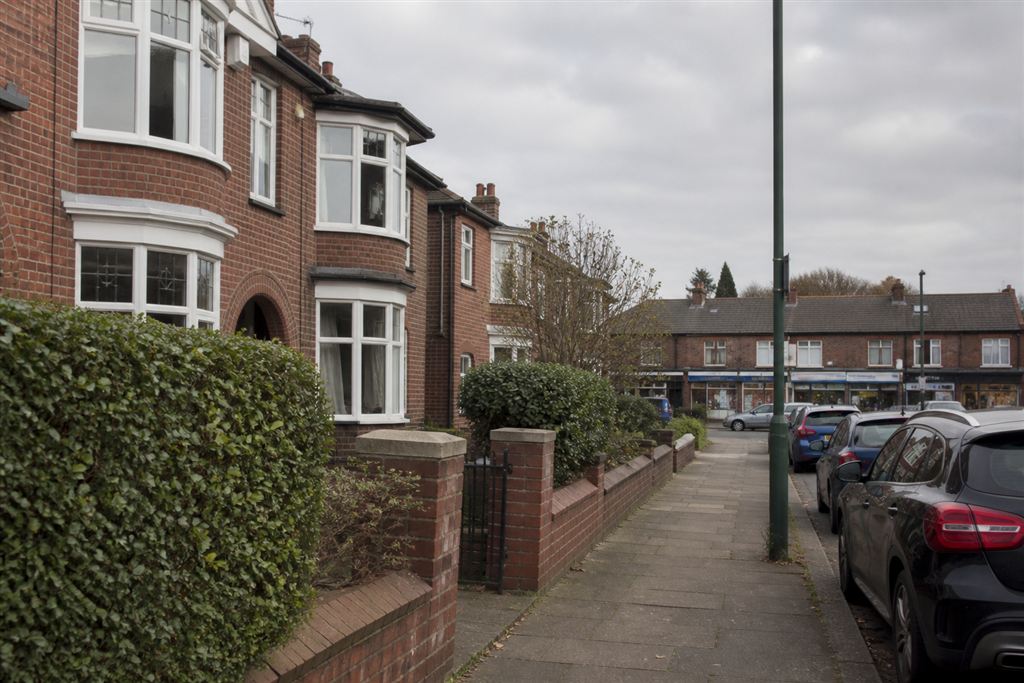
What a wet Moortown cellar usually is
The streets between Harrogate Road, the Outer Ring Road at Moortown Corner, and Shadwell Lane filled in as interwar through-semis: High Moor, Bentcliffe, Falkland, Lidgett-side terraces that look like houses and behave like shared boxes. Many have a single below-ground room under the hall or the rear kitchen, built as coal storage, now a freezer, a boiler, or a dumping ground that smells of wet brick.
The room under them is typically:
- a one-room utility, not a full-height habitable basement
- a through-semi party wall on one long side, sometimes on two if it is mid-terrace fabric
- entered from inside the house, or from a rear alley too narrow for a pallet
- sitting under a plot that parks on the street, not on a private drive
A second, very Moortown type sits under the Street Lane and Moortown Corner parades: cellars under shops, takeaways, and flats, used as stock, beer, or archive, with a pavement hatch, a steep stair from the unit, and trading hours that do not pause for a waterproofing crew. Surface water from the Ring Road / Harrogate Road junction and surcharge from the combined sewer show up here as a wet floor after a cloudburst, not as clay seepage on a golf-course plot.
A third, minority type sits on the Meanwood edge — older gritstone cottages toward Stainbeck Lane and Stonegate Road. Those walls are not millstone-grit Ilkley villas and they are not 1930s Alwoodley Park brick. If that is your house, say so on the form; the survey treats stone and through-semi brick as different rooms.
Houses on the later Moor Allerton / Queenshill slabs, and many 1970s fills, often have no traditional cellar. If the form says “no cellar, just a floor”, we will not invent a Type C job.
This is not Alwoodley’s larger plots
Moortown and Alwoodley share the LS17 ring. They do not share housing, access, or the reason a survey exists.
Alwoodley, immediately north, is later suburban: wider gardens, King Lane / The Avenue / Alwoodley Lane, coal rooms under 1930s–60s semis and detached houses, often a drive, sometimes a garden-level light well. Works there can stay inside without blocking a parade.
Moortown is tighter. Street Lane is a shopping street. Moortown Corner is a traffic junction. Through-semis share cellars at the wall. Shop hatches open onto the pavement. Parking is permit or limited waiting. The process problem is party wall, hatch access, and where a sump can legally discharge when there is no rear lawn. This site is written so a reader of both pages can tell them apart. We do not list Alwoodley as a served town on this domain.
Water here is street runoff and a shared wall, not a beck under a lane
Cellar water in this cell is usually:
- combined-sewer surcharge or rain off Harrogate Road / the Ring Road into a shop cellar at Moortown Corner or along Street Lane
- seepage and tracking at the party wall of a through-semi after a wet week
- a failed or undersized yard gully on a plot with almost no garden
- Meanwood-valley seepage on the Stainbeck / Stonegate edge
It is not Alwoodley Beck passing under King Lane, not clay tracking off a golf course, and not River Aire or canal floodplain water. A specification written for a wide suburban coal hole, or for a Worth Valley back-to-back, will misread the hatch, the neighbour, and the outfall. That is why this site does not share body copy with those towns.
After a Street Lane downpour, a shop owner more often finds standing water at the hatch than a film of salt on a quiet utility floor. shop cellar after a Street Lane downpour
Type C, tanking, and slurry — in the language of a party-wall room
British Standard BS 8102 sets out three ways of dealing with groundwater in a below-ground room. On a Moortown through-semi or a Street Lane stock cellar we explain them like this:
- Type A (barrier) — slurry or bitumen painted or boarded onto the brick, hoping the wall never moves and the neighbour’s cellar never loads the same joint. On a shared wall and around a pavement hatch this is the coating that salts, blisters, and fails first.
- Type B (structurally integral) — the concrete itself is the tank. That is a new-build idea. It is not how a 1930s Street Lane through-semi or a shop parade was put up.
- Type C (cavity drain) — a dimpled membrane on the inside face, a channel at the floor/wall joint, and a sump that takes water to a drain the plot already has a right to use. The brick can still be wet; the room can still be used. This is the honest default on this stock.
tanking a cellar on a Street Lane through-semi cellar tanking when the shop already has slurry Type C in a one-room party-wall cellar
Street Lane specs talk about tanking membrane and cavity drain membrane as linings in a party-wall system. We do not keep those products on a shelf, and this domain is not a shop front on Moortown Corner.
Why a discovery survey comes before any figure
A pavement “free estimate” cannot see:
- whether the only way into the room is a shop hatch on Street Lane, a flat stair, or a through-semi cupboard stair
- whether the neighbour’s cellar is wet on the other side of the party wall, and whether the Party Wall etc. Act 1996 will need a notice before anyone chases that brick
- where a sump can sit in a one-room footprint, and whether a combined drain invert on a tight plot will actually take a pumped outfall
- whether works have to happen after the shop shuts, and whether a tanker can stand on a permit street at all
- whether Leeds Building Control will want a structural-waterproofing application (Moortown is Leeds, same district as Alwoodley — the difference is access and party wall, not the council)
You are paying for a cellar discovery survey with a scope, unless a later operator writes a different policy. A fake free estimate from the Street Lane pavement is not on offer.
Cost is a range with variables, not a doorstep number. Waterproofing a Street Lane stock cellar during trading hours is not the same job as a High Moor through-semi with an internal stair. what changes the price on a tight LS17 plot
Access, not a garden dig
Type C is installed from inside. We do not excavate Street Lane, and we do not close Moortown Corner as a default. Materials go through the unit, the house stair, or a hatch we already have permission to use. On-street parking and permit bays are a survey note, not an afterthought. If a pump-out tanker is needed on a flooded first visit, that is a different conversation — and a different page. Flooded cellar in Moortown where a sump can discharge with no rear yard
Not a citywide list
People searching cellar waterproofing Leeds or basement waterproofing Leeds land on citywide hubs and county “areas we cover” footers. Those two Leeds-modified phrases are small (30 searches a month each ) and this site does not chase them as a title. Moortown is a line on those footers; it is not specified in their surveys.
This page is cellar waterproofing in Moortown. We do not list Alwoodley, Keighley, Ilkley, Bingley, or a forty-town dump. Immediately adjoining streets that are actually Moortown — Street Lane, Moortown Corner, Shadwell Lane, High Moor, Bentcliffe, the Harrogate Road / Ring Road edge, Stainbeck-side gritstone — are in play. Alwoodley’s larger plots are a different cell and a different site, on purpose.
We also do not chase basement waterproofing as a money phrase. In this neighbourhood the room is a cellar — a through-semi utility or a shop stock room. Turning that cellar into a habitable room is an upsell after it is dry. Cellar conversion in Moortown (after waterproofing) Every button on that page still books the waterproofing survey.
FAQs
Street Lane / Moortown Corner properties with a cellar under a shop or flat — can Type C be installed without closing the street?
Yes. Type C cavity drain is fitted from inside the cellar. Street Lane and Moortown Corner stay open. Materials come through the shop, the flat stair, or a pavement hatch we already have permission to use. Closing the carriageway is not the default. It would only arise if a later drainage connection needed a highway licence — the discovery survey says so before anyone talks about a road closure.
Through-semi party wall: does the neighbour’s cellar need to be dry too?
No. We waterproof the room we are contracted on. Water can still sit next door and track at the shared brick. The survey maps that wall. The Party Wall etc. Act 1996 may require notice before we chase or drill it. We do not dry the adjoining house unless that owner books their own survey.
How is Moortown stock different from Alwoodley (do not pretend they are the same)?
Alwoodley is later suburban plots: wider gardens, drives, coal rooms under 1930s–60s houses on streets such as King Lane and The Avenue. Moortown is tighter: Street Lane through-semis, on-street and permit parking, shop and office cellars at Moortown Corner, party-wall process as the main constraint. Same LS17 ring, different access, different discharge, different neighbours. This domain is for Moortown jobs only.
Parking a pump-out tanker on a permit street?
Many side streets off Street Lane are permit or limited waiting. A tanker does not get a free bay because it is a waterproofing visit. The survey notes whether a pump-out can stand with a temporary suspension, whether water can go to a combined drain on the plot, or whether a first-response pump-out has to be timed around restrictions. We do not assume a drive.
If the cellar already has old bitumen/slurry, do we overlay or strip?
On a shop or through-semi cellar the old coating is usually bitumen or cement slurry on brick. A Type C membrane can often go over a failed barrier if the wall is sound enough to fix to. We strip where the coating is loose, salt-blown, or hiding a hatch reveal. Overlay versus strip is a survey call, not a product rule. Detail: cellar tanking when the shop already has slurry Building Control: Leeds, same as Alwoodley, but access and party-wall process is the issue here. Moortown is Leeds City Council Building Control — the same district as Alwoodley. Structural waterproofing of a cellar typically needs a Building Regulations application. What is different on this site is not the council. It is getting people and a sump into a party-wall room, notifying the adjoining owner, and finding a legal discharge on a plot with no rear yard. That is why the discovery survey exists here.